Overview
CEES can offer contracts to outside companies and research organizations through the Texas Tech University cost center. We are permitted to work under the cost center with external customers and may collaborate internally within the university, as appropriate.
Professor Robert Duncan has extensive experience in quantum sensing and low-temperature physics. We offer design, fabrication, and consulting support for the development of quantum systems for both space and terrestrial applications, including:
- Technology for temperature measurement and thermal management, and wire and coaxial cable heat sinking
- Cryogenically-actuated devices for flow and heat control and routing
- Quantum sensing systems using SQUIDs, Josephson junction arrays, and other superconducting system designs
- Superfluid physics and control, and methods of cryogenic cooling of these systems in Earth and space applications
Please contact us for a consultation and to discuss how we can best assist your group’s needs. For a complete list of services, contact Dr. Andrew Gillespie at A.Gillespie@ttu.edu.
Service Rates
Equipment and services available through CEES. Rates are per item unless noted; contact us for a quote on custom work or multi-day projects.
| Equipment / Service | Notes | Internala | Externalb,c |
|---|---|---|---|
| Personnel | |||
| Technician time | $60/hr | Quote | |
| Ph.D. technician time | $100/hr | Quote | |
| Radiation Detection & Nuclear Measurement | |||
| Neutron counters, gamma spectroscopy, etc., with software | Kromek or S-NS; each | $30/day | Quote |
| Neutron spectrometer and activated witness foils with Ge single-crystal gamma readouts, etc. | $45/hr | Quote | |
| 14 MeV neutron generator (3×10⁸) | $100/hr | Quote | |
| CR-39 nuclear track detector | Per piece | $1/cm2 | Quote |
| CR-39 track analysis | $175 per 0.2 cm2 | Quote | |
| Tritium assay analysis (PerkinElmer Quantulus) | Liquid sample | $50/sample | Quote |
| Tritium assay analysis (PerkinElmer Quantulus) | Gas sample | $150/sample | Quote |
| Gas Analysis | |||
| Quantitative gas analysis by FT-ICR mass spectrometry | 4He, 3He, 40Ar / 20Ne | Quote | Quote |
| Vacuum | |||
| Two-stage vane pump | $20/day | Quote | |
| Turbomolecular pump (HiCube 80) with roughing pump | $40/day | Quote | |
| Low and high vacuum pressure gauge | $10/day | Quote | |
| Pulsed Power & Electronics | |||
| 1.6×10⁷ VA pulser | $50/day | Quote | |
| Custom high-power pulser | 10–50 kJ in a 1 ms pulse; cost provided once the design is specified | Quote | Quote |
| Custom power supply | Please specify voltage and current | Quote | Quote |
| Benchtop general low-voltage power supply | Please specify voltage and current range | ~$10/day | Quote |
| Microscopy | |||
| SEM usage | $180/hr | Quote | |
| Design, Fabrication & Simulation | |||
| Mechanical / CAD design | $60/hr | Quote | |
| CNC machining, welding, and 3D printing | $60/hr | Quote | |
| Simulation and modeling | COMSOL & MCNP | $120/hr | Quote |
| Consultation | |||
| Quantum sensing, low-temperature physics, experimental design | Quote | Quote | |
a Internal technical users are Texas Tech University students and Texas Tech University employees who have elected to have analysis performed by Center staff.
b External users are individuals and institutions external to Texas Tech University.
c External non-federal rate: a Facilities and Administration charge of 53% will be added to the final invoice (fiscal year 2023).
Texas Tech is a public, nonprofit educational institution exempt under Section 170(c)(1) of the IRS code.
Rates are subject to change. CR-39 detectors and several of these services are also available through our commercial partner, BlankSlate Innovation.
Gas Analysis
Quantitative helium-4, helium-3, argon-40, and neon-20 analysis; tritium assay; and custom analyses.
Mass spectrometry services
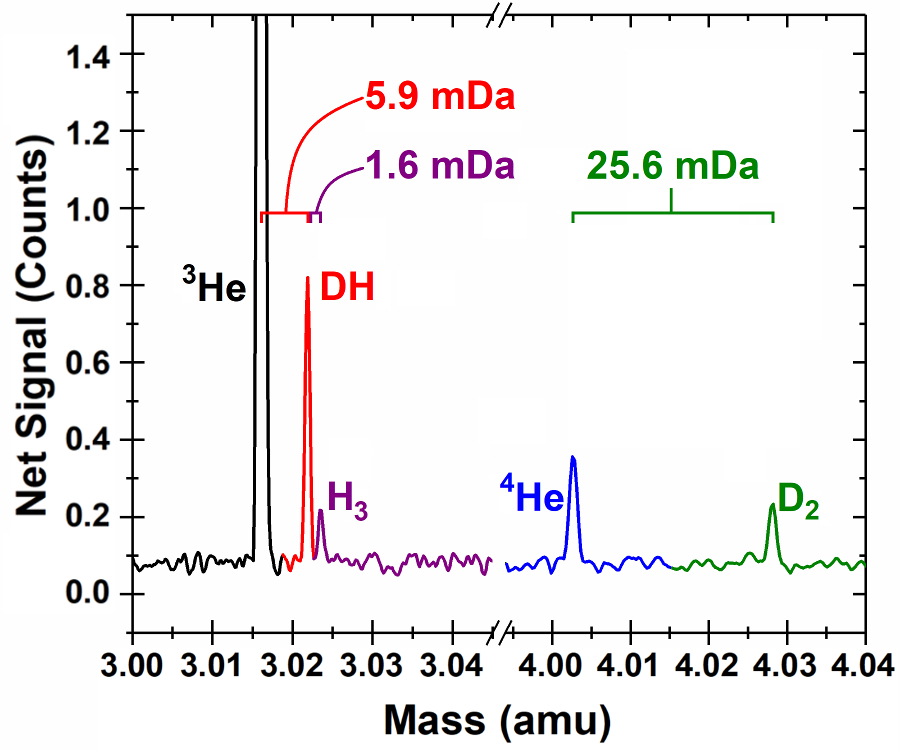
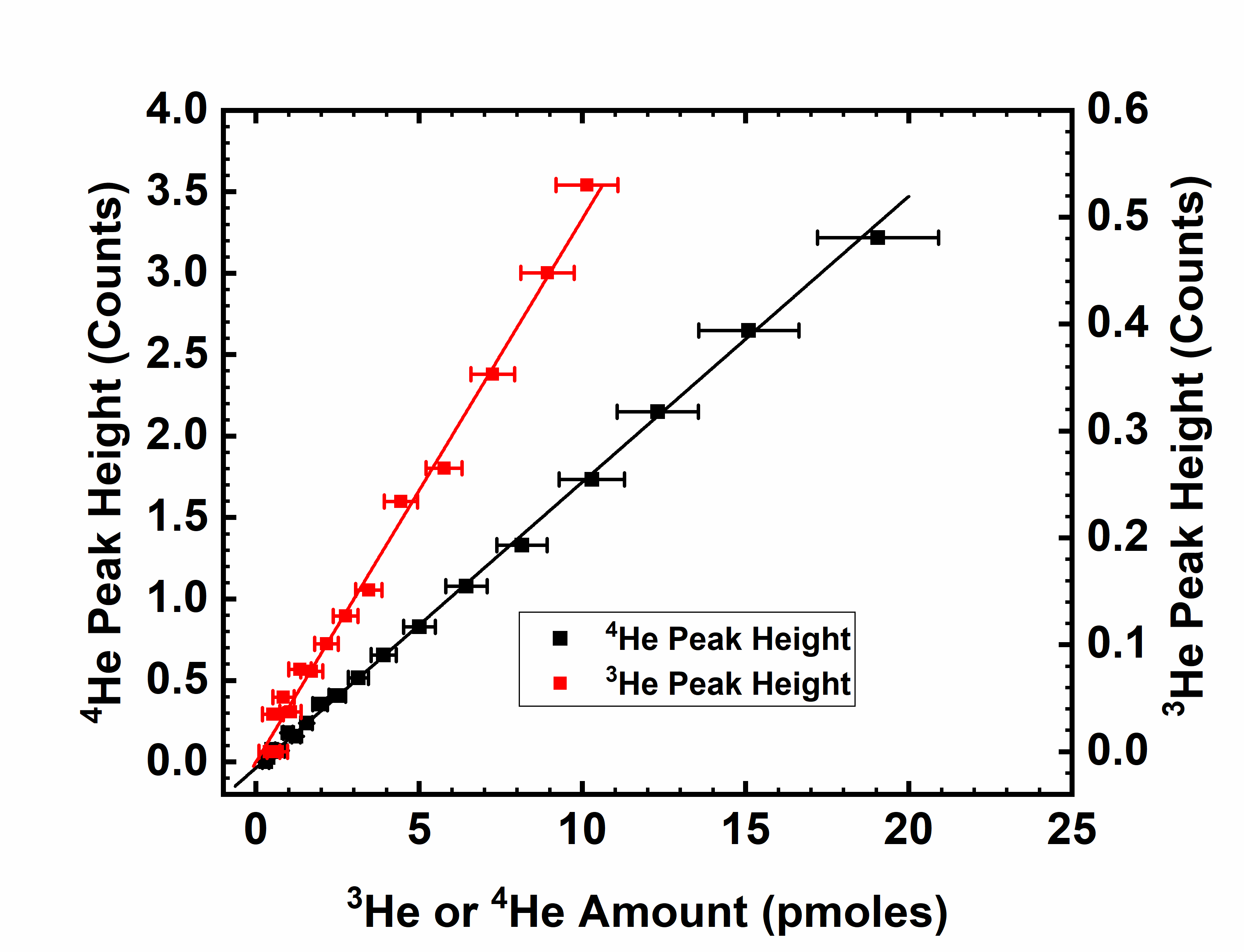
Mass spectrometry, including Fourier transform ion cyclotron resonance (FT-ICR), measures low-mass components in gas mixtures to low ppb levels. The CEES mass spectrometer team uses two types of mass spectrometers for testing client gas samples. For qualitative testing (identification of the species present), a quadrupole gas analyzer with an electron impact (EI) ionizer is used; its upper mass limit is 300 amu. Quantitative analysis is primarily performed for the noble gases (e.g., helium-3, helium-4, neon, argon, and others) using an FT-ICR mass spectrometer with an EI ionizer. A sample pretreatment process concentrates the noble gases by removing the matrix components before injection into the mass spectrometer.
Routine calibrations with an external calibrant provide accurate quantitative measurements down to below 0.1 ppm for helium-4. The FT-ICR has excellent resolution in the mass range below 15 amu, with the ability to achieve a mass resolution better than 0.0001 Da at mass 3. For more detail, see Mass Spectrometry.
Tritium assay
Tritium activity is measured with a PerkinElmer Quantulus liquid scintillation counter. See Tritium Extraction.
Materials Fabrication & Analysis
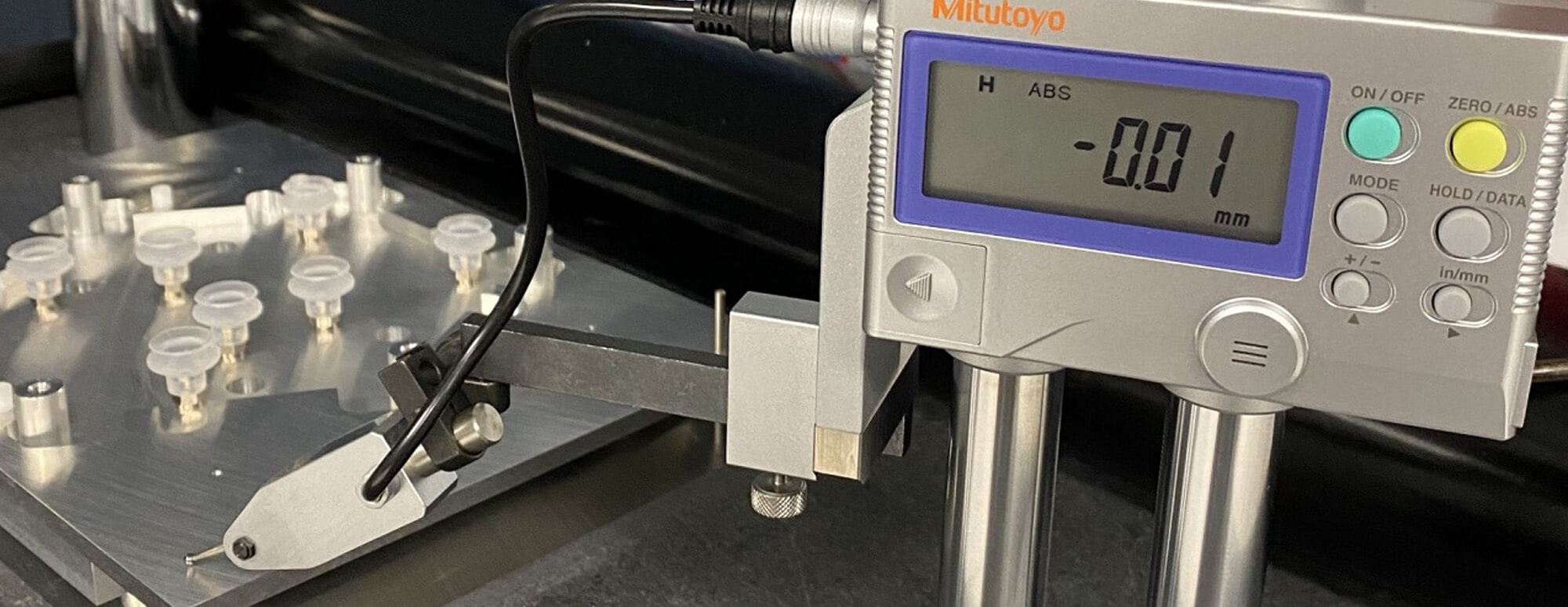
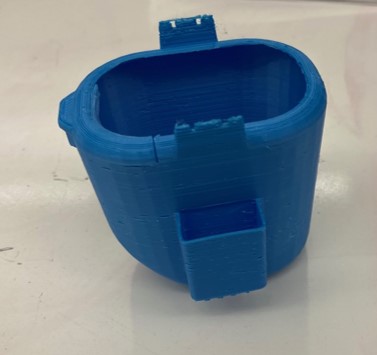
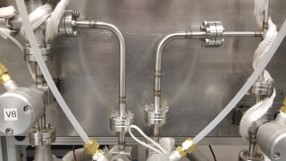
Characterization, visualization, synthesis, and fabrication, including CNC machining and 3D printing and orbital welding. We provide access to top-quality components suitable for fast prototyping and low-volume industrial production through FDM 3D printing, and orbital welding for tubing from 1/8″ to 1/2″ in diameter.
Radiation detector calibration
- Gamma spectrometers and survey meters: Co-60, Cs-137
- Alpha spectrometers and survey meters: Am-241
- Neutron spectrometers and survey meters: Cf-252, AmBe
Systems Design
- Electronic: our scientists have designed and built a Fourier transform ion cyclotron resonance mass spectrometer, a sensor integration block for CPAP and other breathing devices, a low-noise universal power supply, a high-current digitally controlled pulser for high magnetic field applications, open-circuit voltage decay systems, and more. See Electronic Systems.
- Mechanical / CAD: see Machining & 3D Printing and Orbital Welding.
- Simulation: MCNP and COMSOL. See MCNP and COMSOL.
- Quantum sensing and low-temperature physics.
- Software design: Windows applications, LabVIEW, data exploration.
Instruction & Training
Cryogenics, quantum sensing, space physics, and self-organized criticality. See Superfluidity, Superconducting Electronics, and Low Temperature Physics.
- Cryogenic support systems for quantum sensing
- Experimental techniques for fundamental physics in space
- Quantum sensing, quantum electrical standards, and near quantum-limited measurements
- Self-organized criticality (SOC) and novel transport in superfluids
Disclaimer on Services & Consulting
We are happy to provide expert advice on experimental design, measurement capabilities, and more. However, we are not able to provide any product endorsement. We are only able to provide factual evidence of the measurements we make.